
I reviewed Gus Van Sant’s feature Dead Man’s Wire for the April 2026 issue of Sight & Sound. The review is reproduced here with permission.
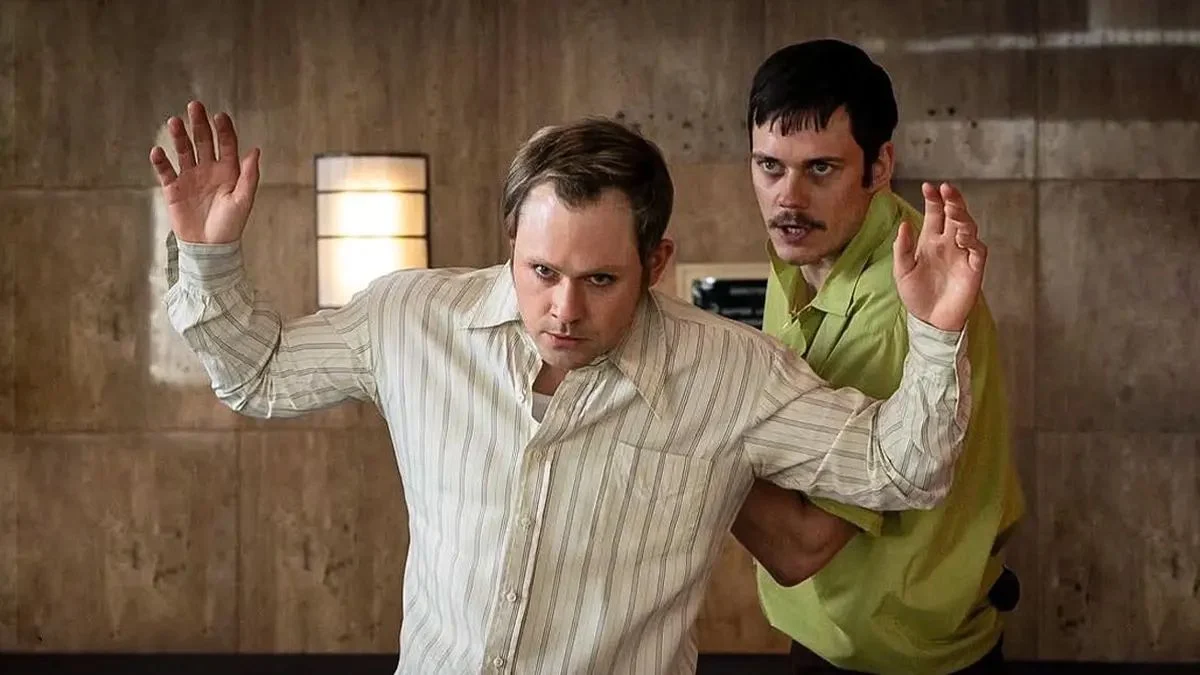
Is it too much, in this world, to ask for “some goddamn catharsis, some genuine guilt” to be apportioned to the terrible people who live well on the misery of others? That’s what Tony Kiritsis (Bill Skarsgård, pictured right) is seeking in Dead Man’s Wire, Gus Van Sant’s dramatisation of a peculiar historical episode. In Indianapolis in 1977, Kiritsis took hostage Dick Hall (played here by Dacre Montgomery, pictured left), son and colleague of mortgage magnate ML Hall (Al Pacino), motivated by the collapse of a real-estate deal that Kiritsis hoped would result in a shopping centre for the common man. Key among his demands was a public apology for the underhanded and exploitative business practices he believed were used by the Halls – though not, we could add with understatement, only by them. Regardless of the outcome of this stand-off, we know what happened next: rapacious finance capitalism ate the world and catharsis and guilt can go whistle.
The late 70s offer a fruitful setting for this strange morality tale, which in Van Sant’s hands is at once jocular and baleful, nostalgic and timely. The moral, social, economic and political stakes are not hard to discern but Dead Man’s Wire is also an intensely aesthetic undertaking, self-consciously evoking the media landscape of the period. It does this narratively, by foregrounding televised hostage-taking as a form of spectacular militancy, in which seizing human beings becomes a way of seizing the airwaves; and it does it formally, by evoking contemporary cinematic representations of the televised acting out of conflict, trauma, frustration and alienation. Network (1976) comes to mind (Tony is mad as hell, all right), as does Dog Day Afternoon (1975), with the piquant turn that, this time, Pacino plays not a desperate, scrappy idealist but the kind of douchebag who complains that his poolside burrito has been cut the wrong way.
Pacino gives plenty of juice in his few brief scenes but it’s mostly Skarsgard’s show. He too finds much humour in his character’s situation, variously tapping into goofy physicality, screwball logistics and apoplectic emoting. Montgomery is the straight guy in the set-up, his sober, sinking apprehension keeping the immediate human threat in sight. He nicely conveys Dick’s understanding that he is jeopardised at least as much by his father’s toxic narcissism as by his kidnapper’s ire. Meanwhile, Colman Domingo and Myha’la offer an intriguing kind of media chorus on the situation: Domingo plays legendary local DJ Fred Temple, who becomes something of an on-air father confessor to Tony, while Myha’la is Linda Page, a budding local TV news reporter in search of a big break. One is grizzled but not jaded, the other fresh but not naïve, each contingently embroiled yet able to take a somewhat disinterested perspective on this strange situation in which, as Page puts it, “a white guy strapped a shotgun to another white guy’s head”. (It’s this booby-trap set-up – a kind of failsafe mechanism intended to ensure the captive’s death in the event of the kidnapper’s incapacitation – that gives the film its title.)
The white-on-white nature of the incident draws attention to its structural context. This hostage-taking isn’t a matter of anti-imperialism or radical liberation but rather of wanting to call the rich man’s bluff: a form of class politics, perhaps, but (shotgun notwithstanding) a relatively mild one, an appeal to natural justice, the little man just wanting his share of the American dream. The dramatic irony is strongest here: poor sap, we have to think. For all the period details – the orange-brown-avocado palette, the funk soul soundtrack, the still photos, magnetic tape and shaky 16mm-style reportage footage – there’s an unmistakably contemporary tang. We find ourselves today at the tail end of the arc whose ascent begins here, as the local shock troops of neoliberalism – what Tony calls the “biggest devils there are, loan companies” – gird themselves for the field and smack their chops.
In Dead Man’s Wire, the real conflict, the real dramatic crux, turns around who apologises to whom for what and with what consequences – and whether any pressure exists that can get a man like ML to acknowledge harm, take accountability and conceive of human affairs as a matter of empathetic collaboration rather than competitive advantage. “Admit what you are and say that you’re sorry,” runs Tony’s impossible demand. What happens when it becomes evident this won’t happen? Unsurprisingly, discussion of the film has included mention of Luigi Mangione.
Dead Man’s Wire is released in the UK on March 20th 2026.