
I reviewed the 4K Blu-Ray release of Pink Narcissus for the September 2026 issue of Sight & Sound. The review is reproduced here with permission.
“I really do like to be my own little pioneer,” James Bidgood said. That’s one way to describe his achievement with Pink Narcissus. A sui generis erotic fantasia created on a shoestring over many years, mostly in Bidgood’s tiny New York apartment, it offers a cohesively delirious vision of gay male desire and of cinema itself.
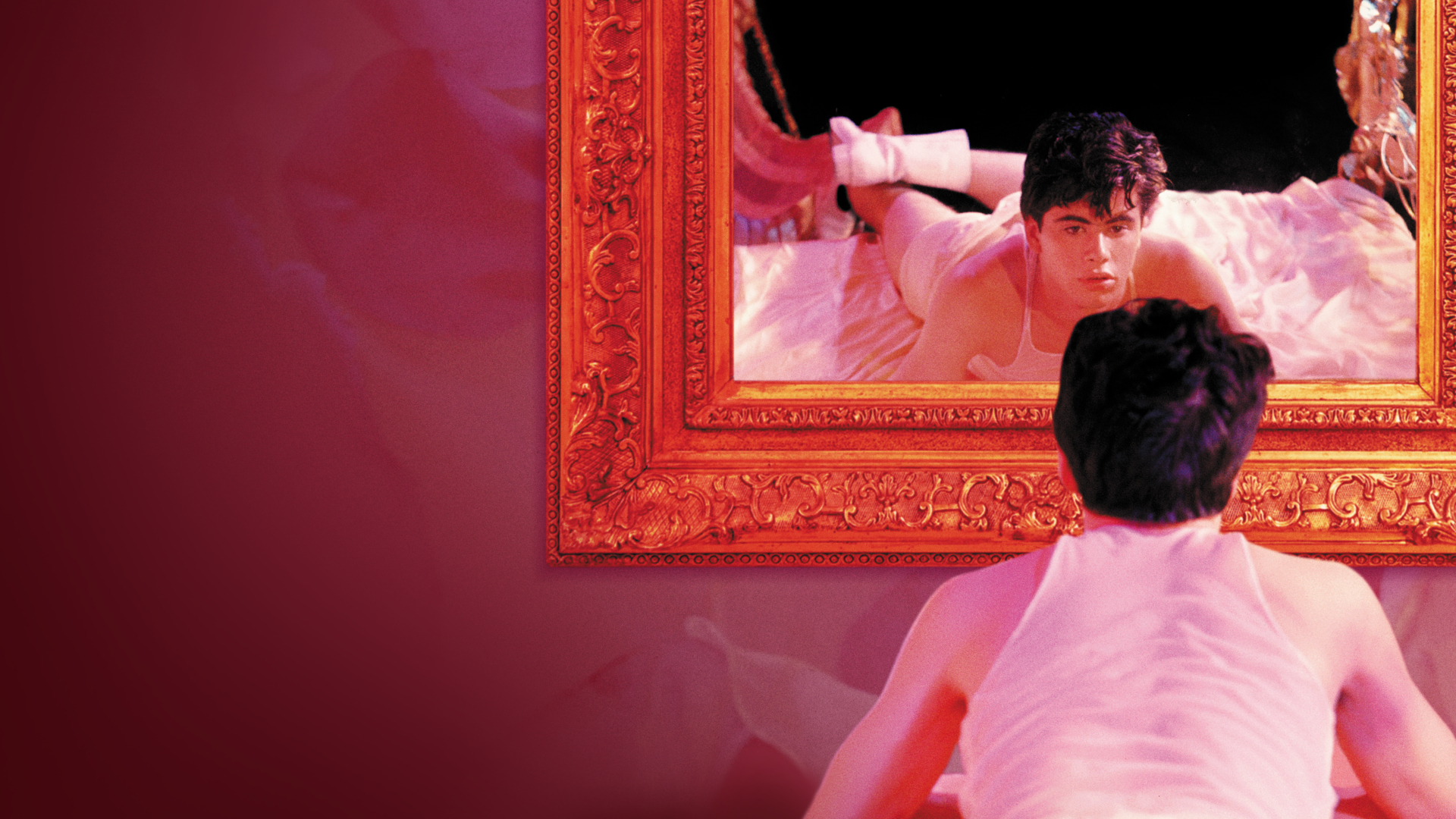
Pink Narcissus presents a stylised day in the life of a call boy (Bobby Kendall) whom we meet lounging sensuously in his boudoir. A series of vignettes positions him across a range of nakedly homosexual scenarios, from mythic woodland idylls to urban nightscapes, taking in bullrings and bikers, plutocrats and harems, lush foliage, fairytale castles, chiffon gauzes and animated butterflies, via spray-on pink-and-gold toreador tights and the most outrageous navel shot ever filmed. The colours are intoxicatingly intense, the effects expressionistic and experimental, the score (overseen by Martin Jay Sadoff) a cunning blend of romantic orchestral snippets, pop and TV sounds and even electronica. At the centre is Kendall, serving not beefcake trade but pretty, pouty and fabulous, by turns dreamy, puckish, horny and aloof. This angle or that lighting choice makes him coquettish, colossal or forlorn.
Originally from Wisconsin, Bidgood had worked across costume and set design, physique photography, high-end drag and socialite soirées before he began shooting Pink Narcissus on 8mm in 1963. Thinking of short physique posing reels, he planned to create a series of standalone scenes before a non-narrative feature-length arc emerged. He had costumes and props from his other work, a clear, powerful vision and an indefatigable work ethic. This meant he could do things just so, from constructing handmade glittery motorbikes out of cardboard to composing lengthy jungle tracking shots on his kitchen table.
He also had a preternatural lack of shame or fear around gay identity and expression. “I never knew what a closet was,” he said. This cut both ways: the relaxed nudity and unabashed desire of Pink Narcissus are subversive by their nature yet, although shooting spanned the immediate pre- and post-Stonewall period, this was not a consciously political project. In some ways it was the opposite: Bidgood wanted to expand norms, not overthrow them. “We should look at men the same way we look at women,” he said, “just as glamorously.” It’s hard, viewing Pink Narcissus, not to think of seminal expressions of heady queer desire from Jean Genet, Kenneth Anger or Jack Smith. Yet Bidgood was more influenced by the Technicolor splendours of The Wizard of Oz (1939) and The Thief of Baghdad (1941), and the variously potent visual languages of silent cinema, Disney animation, Playboy photo spreads and the fantasy illustrations of Maxfield Parrish. John Waters called him an outsider artist but he just wanted a slice of the cheesecake already being served to others. He had to make it himself and ended up with something even more tasty.
Pink Narcissus reproduces surprisingly well the swooning, transporting effects of conventional Hollywood glamour. It also reproduces a number of questionable studio norms, including the othering and orientalist stylings of, say, the harem and toreador sequences, and Bidgood’s initial casting – and renaming – of “Bobby Kendall” from a street encounter when he was 16. Bidgood was clearly besotted with this straight kid from Brooklyn who had a heart of gold, the laugh of a donkey, serious smarts and an utter lack of self-regard. “He looked in the mirror, he didn’t see what we all saw,” Bidgood noted. This non-narcissistic Narcissus had the beauty, charisma and element of distance or blankness to make for a magnetic screen presence and the collaboration endured for years. The power dynamic can hardly have been equal and their eventual falling out necessitated the use of body doubles later in the production. They remained in touch throughout Bidgood’s later life.
Eventually Bidgood secured modest backing from Sherpix, a semi-legit distributor, enabling the shooting of relatively ambitious scenes in 16mm on a set. However, the perfectionist vision that drove him saw him ejected from the editing suite, Welles-style, in 1971, when Sherpix grew impatient and exercised their ownership rights. Aghast at the half-baked release, Bidgood took his name off the credits and inadvertently sparked years of directorial speculation (Warhol? Anger? A studio big-shot?). He too lacked narcissism. His monomania instead involved the pursuit of an artistic vision at once utterly idiosyncratic and adoringly imitative. Besotted with conventional glamour, he seems barely to have considered that its generation might depend, on the production side, on industrial-scale economic and mechanical practices and, on the reception side, on structurally determined mass understandings of gender and desire. So he created a movie that, by rights, should have been impossible to make or to show. Indeed, so it seemed when he lost control and it was rushed out to minimal interest. Incredibly, it persisted as a curiosity, then a cult item, then a recognised classic, its echoes reverberating through Waters and Fassbender to Pierre et Gilles and Cole Escola. Bidgood reclaimed his credit in 1991 and lived until 2022.
This new restoration by the UCLA Film & Television Archive leaves enough artifacts to evoke the film’s DIY origins but marks a significant improvement from previous commercial releases, addressing scratches, missing frames and the many hairs left in gates by Bidgood’s eight cats. Enlightening extras include Brian Robinson’s interview with Bidgood (seen on the previous BFI DVD), a new NYC Q&A and details about the restoration.
Obviously, with its acres of chiffon, handcrafted urinals and lunar close-ups of nipples, Pink Narcissus should be too much. Yet it’s just right. Perhaps this is because of its perfect mesh between form and content, subject and projection, artist and muse. Kendall serves simultaneously as Bidgood’s object of desire and his stand-in; together, they deliver a self-portrait of the dreamer weaving gorgeousness from whole cloth without leaving his room. Bobby’s ‘real’ life – all jewel-encrusted telephones, cigarette cases and LPs – is no more or less real than his visions. And the film insists that its naively idealised swoonathon, determined and enabled by the camera, is no more or less real a way of being in the world than any other. Ethereal and filthy, handmade and studio-worthy, gauzily mythic and scabrously satirical, preposterously artificial and utterly sincere, the film contains multitudes. It’s serious about fantasy, and what could be more cinematic than that?
The 4K restoration of Pink Narcissus is available from the BFI Shop and to watch on the BFI Player.